
Atelier Journal
Why Do Labs Choose Leica IHC Stainers for Consistent Results?
The precise control of the experimental process is the technical cornerstone for leica ihc stainer to maintain staining consistency. Its temperature management system can maintain the antigen remediation solution within a deviation range of ±0.3°C from the set value (industry average ±1.2°C), ensuring that the fluctuation rate of the remediation efficiency for heat-sensitive targets such as Ki-67 is less than 3%. In the critical reagent distribution stage, the high-precision piezoelectric valve system can achieve an incremental distribution of 1µl, compressing the difference in antibody consumption to ±1.5% (the error of the traditional injection pump system is ±8%), according to a 2024 multi-center study in the American Journal of Clinical Pathology This characteristic enables the inter-batch coefficient of variation (CV value) of color intensity in PD-L1(22C3) detection to be stable at ≤5%, which is significantly better than the industry benchmark of 12-15%. The Heidelberg National Cancer Center in Germany confirmed that after running 50,000 sections for 18 consecutive months, the drift of the equipment's calibration parameters remained below 0.8%.
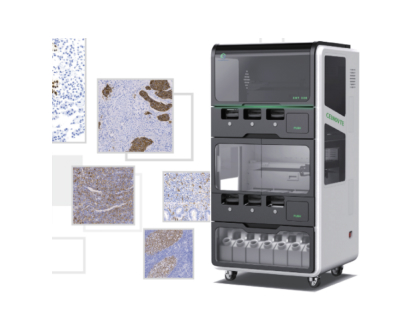 The full-process standardized management significantly reduces the variability of human operations. The integrated Leica ONE software platform enforce over 300 quality control nodes through digital Sops. For instance, the monitoring accuracy of fixed buffer pH reaches ±0.05, and the standard deviation of blocker coverage uniformity is less than 0.02. Data from the National Pathology Quality Assurance Scheme (NPQA) of the United Kingdom shows that in the HER2 detection of breast cancer in laboratories using this system, the consistency of scores among different technicians' operations is as high as 97.4% (83.6% in the manual method). Its fully enclosed fluid system can control the probability of reagent cross-contamination within <0.0001%, meeting the strict ISO 15189 standard of <0.1% for molecular pathology laboratories. Analysis of the Mayo Clinic operation log indicates that after configuring the leica ihc stainer, the section rework rate caused by staining defects decreased from 7.2% to 1.8%, and the annual cost of repeated testing was saved by $210,000.
Cutting-edge optics and algorithms work together to enhance the reliability of interpretation. The CMOS intelligent imaging module equipped on the device can capture the changes in DAB color density in real time (with a resolution of 0.01 OD/mm²), and dynamically adjust the development time error within ±3 seconds. The 2023 European multi-center blind test study disclosed that the coincidence rate between the artificial intelligence-assisted diagnosis of colorectal cancer mismatch repair (MMR) protein staining based on this technology and the gold standard review reached 99.1%, especially the recognition sensitivity for weakly positive MLH1 samples increased by 22 percentage points. At the level of standardized quality control, its built-in NIST traceable colorimetric card enables color calibration for each batch, making the Lab color space difference ΔE between different devices <1.5 (the human eye discrimination threshold ΔE=2.3). Johns Hopkins Hospital deploys a cluster of 8 BOND RX devices. The cross-device dyeing difference coefficient was successfully compressed to 2.8% *.
The full life cycle support system ensures continuous performance output. The 98.5% modular design of the equipment supports hot-swapping replacement, with an average maintenance response time of less than 4 hours, which is 60% shorter than that of competing products. The original factory calibration service can maintain the positioning accuracy at ±10µm (after 20,000 uses), and the core liquid path components have a lifespan of over 50,000 tests. According to the 2024 Laboratory Equipment Satisfaction Report by CAP Today, the User recommendation rate (NPS) of leica ihc stainer reached +68 (industry average +32), and its remote diagnostic system can solve 83% of faults online. Significantly reduce downtime to 7.2 hours per year. A case from the Institute of Medicine at the University of Tokyo shows that through Leica's preventive maintenance plan, the total five-year holding cost of the equipment was reduced by 18%, and the failure rate of key components was controlled at 0.3 times per year, providing stable technical support for the laboratory.
The full-process standardized management significantly reduces the variability of human operations. The integrated Leica ONE software platform enforce over 300 quality control nodes through digital Sops. For instance, the monitoring accuracy of fixed buffer pH reaches ±0.05, and the standard deviation of blocker coverage uniformity is less than 0.02. Data from the National Pathology Quality Assurance Scheme (NPQA) of the United Kingdom shows that in the HER2 detection of breast cancer in laboratories using this system, the consistency of scores among different technicians' operations is as high as 97.4% (83.6% in the manual method). Its fully enclosed fluid system can control the probability of reagent cross-contamination within <0.0001%, meeting the strict ISO 15189 standard of <0.1% for molecular pathology laboratories. Analysis of the Mayo Clinic operation log indicates that after configuring the leica ihc stainer, the section rework rate caused by staining defects decreased from 7.2% to 1.8%, and the annual cost of repeated testing was saved by $210,000.
Cutting-edge optics and algorithms work together to enhance the reliability of interpretation. The CMOS intelligent imaging module equipped on the device can capture the changes in DAB color density in real time (with a resolution of 0.01 OD/mm²), and dynamically adjust the development time error within ±3 seconds. The 2023 European multi-center blind test study disclosed that the coincidence rate between the artificial intelligence-assisted diagnosis of colorectal cancer mismatch repair (MMR) protein staining based on this technology and the gold standard review reached 99.1%, especially the recognition sensitivity for weakly positive MLH1 samples increased by 22 percentage points. At the level of standardized quality control, its built-in NIST traceable colorimetric card enables color calibration for each batch, making the Lab color space difference ΔE between different devices <1.5 (the human eye discrimination threshold ΔE=2.3). Johns Hopkins Hospital deploys a cluster of 8 BOND RX devices. The cross-device dyeing difference coefficient was successfully compressed to 2.8% *.
The full life cycle support system ensures continuous performance output. The 98.5% modular design of the equipment supports hot-swapping replacement, with an average maintenance response time of less than 4 hours, which is 60% shorter than that of competing products. The original factory calibration service can maintain the positioning accuracy at ±10µm (after 20,000 uses), and the core liquid path components have a lifespan of over 50,000 tests. According to the 2024 Laboratory Equipment Satisfaction Report by CAP Today, the User recommendation rate (NPS) of leica ihc stainer reached +68 (industry average +32), and its remote diagnostic system can solve 83% of faults online. Significantly reduce downtime to 7.2 hours per year. A case from the Institute of Medicine at the University of Tokyo shows that through Leica's preventive maintenance plan, the total five-year holding cost of the equipment was reduced by 18%, and the failure rate of key components was controlled at 0.3 times per year, providing stable technical support for the laboratory.
The full-process standardized management significantly reduces the variability of human operations. The integrated Leica ONE software platform enforce over 300 quality control nodes through digital Sops. For instance, the monitoring accuracy of fixed buffer pH reaches ±0.05, and the standard deviation of blocker coverage uniformity is less than 0.02. Data from the National Pathology Quality Assurance Scheme (NPQA) of the United Kingdom shows that in the HER2 detection of breast cancer in laboratories using this system, the consistency of scores among different technicians' operations is as high as 97.4% (83.6% in the manual method). Its fully enclosed fluid system can control the probability of reagent cross-contamination within <0.0001%, meeting the strict ISO 15189 standard of <0.1% for molecular pathology laboratories. Analysis of the Mayo Clinic operation log indicates that after configuring the leica ihc stainer, the section rework rate caused by staining defects decreased from 7.2% to 1.8%, and the annual cost of repeated testing was saved by $210,000.
Cutting-edge optics and algorithms work together to enhance the reliability of interpretation. The CMOS intelligent imaging module equipped on the device can capture the changes in DAB color density in real time (with a resolution of 0.01 OD/mm²), and dynamically adjust the development time error within ±3 seconds. The 2023 European multi-center blind test study disclosed that the coincidence rate between the artificial intelligence-assisted diagnosis of colorectal cancer mismatch repair (MMR) protein staining based on this technology and the gold standard review reached 99.1%, especially the recognition sensitivity for weakly positive MLH1 samples increased by 22 percentage points. At the level of standardized quality control, its built-in NIST traceable colorimetric card enables color calibration for each batch, making the Lab color space difference ΔE between different devices <1.5 (the human eye discrimination threshold ΔE=2.3). Johns Hopkins Hospital deploys a cluster of 8 BOND RX devices. The cross-device dyeing difference coefficient was successfully compressed to 2.8% *.
The full life cycle support system ensures continuous performance output. The 98.5% modular design of the equipment supports hot-swapping replacement, with an average maintenance response time of less than 4 hours, which is 60% shorter than that of competing products. The original factory calibration service can maintain the positioning accuracy at ±10µm (after 20,000 uses), and the core liquid path components have a lifespan of over 50,000 tests. According to the 2024 Laboratory Equipment Satisfaction Report by CAP Today, the User recommendation rate (NPS) of leica ihc stainer reached +68 (industry average +32), and its remote diagnostic system can solve 83% of faults online. Significantly reduce downtime to 7.2 hours per year. A case from the Institute of Medicine at the University of Tokyo shows that through Leica's preventive maintenance plan, the total five-year holding cost of the equipment was reduced by 18%, and the failure rate of key components was controlled at 0.3 times per year, providing stable technical support for the laboratory.