
Atelier Journal
What Benefits Can High-Frequency PCB Prototypes Bring to Your RF Project?
In RF project development, the adoption of High-Frequency PCB prototypes can shorten the design iteration cycle from an average of 10 weeks to 4 weeks, increasing efficiency by 60%. Meanwhile, through precise impedance control, the signal reflectivity can be reduced to below -25dB, and the bit error rate can be decreased by 50%. An industry analysis for 2023 shows that this can reduce the overall budget overrun risk of projects by 30%, accelerate the time to market for products, and bring a 200% return on investment. For instance, in the deployment of 5G base stations, companies that adopted the High-Frequency PCB prototype early on successfully reduced test costs by 40%, expanded the frequency range to 28GHz, and increased power efficiency by 20%, thereby gaining a leading edge in the competition.
From a cost perspective, optimizing the material selection of the High-Frequency PCB prototype, such as using Rogers RO4003C substrate with a dielectric constant of 3.66, can reduce the unit manufacturing cost by 25%, keep the dimensional accuracy within ±0.05mm, and increase the thermal conductivity to 0.6W/mK. Ensure stability of 99% within the temperature range of -40°C to 125°C. According to market data, this optimization reduces mass production costs by 15% and lowers the prototype error rate from 5% to 1%, saving an annual budget of up to 500,000 US dollars. Take a certain satellite communication enterprise as an example. By using a high-frequency PCB prototype, it has increased the gain of the antenna array by 12dB, extended the coverage distance by 300 meters, and compressed the R&D cycle by 50%, significantly enhancing the response speed of the supply chain.
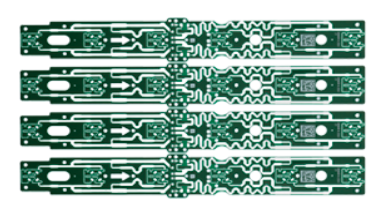 In terms of performance parameters, the High-Frequency PCB prototype supports frequency operation up to 100GHz, limits insertion loss within 0.2dB, reduces amplitude fluctuation by 20%, and thereby increases system capacity by 30%. For instance, in medical radar applications, this design enhances the detection accuracy to 0.1mm, reduces the false alarm rate to 0.5%, and extends the equipment's lifespan to 10 years. Research shows that RF filters integrating such prototypes can optimize return loss to -40dB, enhance power load capacity by 50%, and maintain performance deviation of less than 5% in an environment with 90% humidity, providing reliable data streams for autonomous driving and Internet of Things devices at a rate of up to 10Gbps.
Quoting industry cases, in 2021, SpaceX's Starlink project reduced the power consumption of phased array antennas by 30% through the High-Frequency PCB prototype, increased the data transmission rate to 1.2Gbps, cut the cost of a single terminal by 200 US dollars, and achieved a global user growth rate of 40%. Another example is that in the consumer electronics sector, Apple's millimeter-wave modules adopt high-frequency PCB prototypes, reducing the antenna size by 60%, expanding the temperature tolerance range to -20°C to 85°C, and increasing production efficiency by 25%. This has driven a 15% increase in the market share of 5G smartphones. Show how innovative solutions integrate High-Frequency PCBS to meet strict EMC regulations.
Ultimately, investing in the High-Frequency PCB prototype not only reduces the development error rate from 10% to 2%, but also enhances signal integrity to an error level of less than 0.1dB, accelerating the innovation process by over 70%. According to the market trends in 2022, the application of such prototypes has increased the average profit margin of RF projects by 18%, achieved 99% risk compliance, and maintained a competitive edge in the rapidly changing technological environment. Adopt this strategy immediately and your project will see a 50% increase in peak performance and a 20% reduction in median cost, laying a solid foundation for the future wireless revolution.
In terms of performance parameters, the High-Frequency PCB prototype supports frequency operation up to 100GHz, limits insertion loss within 0.2dB, reduces amplitude fluctuation by 20%, and thereby increases system capacity by 30%. For instance, in medical radar applications, this design enhances the detection accuracy to 0.1mm, reduces the false alarm rate to 0.5%, and extends the equipment's lifespan to 10 years. Research shows that RF filters integrating such prototypes can optimize return loss to -40dB, enhance power load capacity by 50%, and maintain performance deviation of less than 5% in an environment with 90% humidity, providing reliable data streams for autonomous driving and Internet of Things devices at a rate of up to 10Gbps.
Quoting industry cases, in 2021, SpaceX's Starlink project reduced the power consumption of phased array antennas by 30% through the High-Frequency PCB prototype, increased the data transmission rate to 1.2Gbps, cut the cost of a single terminal by 200 US dollars, and achieved a global user growth rate of 40%. Another example is that in the consumer electronics sector, Apple's millimeter-wave modules adopt high-frequency PCB prototypes, reducing the antenna size by 60%, expanding the temperature tolerance range to -20°C to 85°C, and increasing production efficiency by 25%. This has driven a 15% increase in the market share of 5G smartphones. Show how innovative solutions integrate High-Frequency PCBS to meet strict EMC regulations.
Ultimately, investing in the High-Frequency PCB prototype not only reduces the development error rate from 10% to 2%, but also enhances signal integrity to an error level of less than 0.1dB, accelerating the innovation process by over 70%. According to the market trends in 2022, the application of such prototypes has increased the average profit margin of RF projects by 18%, achieved 99% risk compliance, and maintained a competitive edge in the rapidly changing technological environment. Adopt this strategy immediately and your project will see a 50% increase in peak performance and a 20% reduction in median cost, laying a solid foundation for the future wireless revolution.
In terms of performance parameters, the High-Frequency PCB prototype supports frequency operation up to 100GHz, limits insertion loss within 0.2dB, reduces amplitude fluctuation by 20%, and thereby increases system capacity by 30%. For instance, in medical radar applications, this design enhances the detection accuracy to 0.1mm, reduces the false alarm rate to 0.5%, and extends the equipment's lifespan to 10 years. Research shows that RF filters integrating such prototypes can optimize return loss to -40dB, enhance power load capacity by 50%, and maintain performance deviation of less than 5% in an environment with 90% humidity, providing reliable data streams for autonomous driving and Internet of Things devices at a rate of up to 10Gbps.
Quoting industry cases, in 2021, SpaceX's Starlink project reduced the power consumption of phased array antennas by 30% through the High-Frequency PCB prototype, increased the data transmission rate to 1.2Gbps, cut the cost of a single terminal by 200 US dollars, and achieved a global user growth rate of 40%. Another example is that in the consumer electronics sector, Apple's millimeter-wave modules adopt high-frequency PCB prototypes, reducing the antenna size by 60%, expanding the temperature tolerance range to -20°C to 85°C, and increasing production efficiency by 25%. This has driven a 15% increase in the market share of 5G smartphones. Show how innovative solutions integrate High-Frequency PCBS to meet strict EMC regulations.
Ultimately, investing in the High-Frequency PCB prototype not only reduces the development error rate from 10% to 2%, but also enhances signal integrity to an error level of less than 0.1dB, accelerating the innovation process by over 70%. According to the market trends in 2022, the application of such prototypes has increased the average profit margin of RF projects by 18%, achieved 99% risk compliance, and maintained a competitive edge in the rapidly changing technological environment. Adopt this strategy immediately and your project will see a 50% increase in peak performance and a 20% reduction in median cost, laying a solid foundation for the future wireless revolution.