
Perfumery Training for Spa and Hotel Teams: Mistakes to Avoid
The mistakes a spa or hotel brand makes with fragrance are briefing mistakes, and they are fixed by training, not by a more patient factory. A team that can name a scent family, describe intensity and place a sample in time will get a perfumer's answer in one round. A team that cannot will burn sampling rounds describing moods. Buy the training before the second sampling round and it pays for itself.
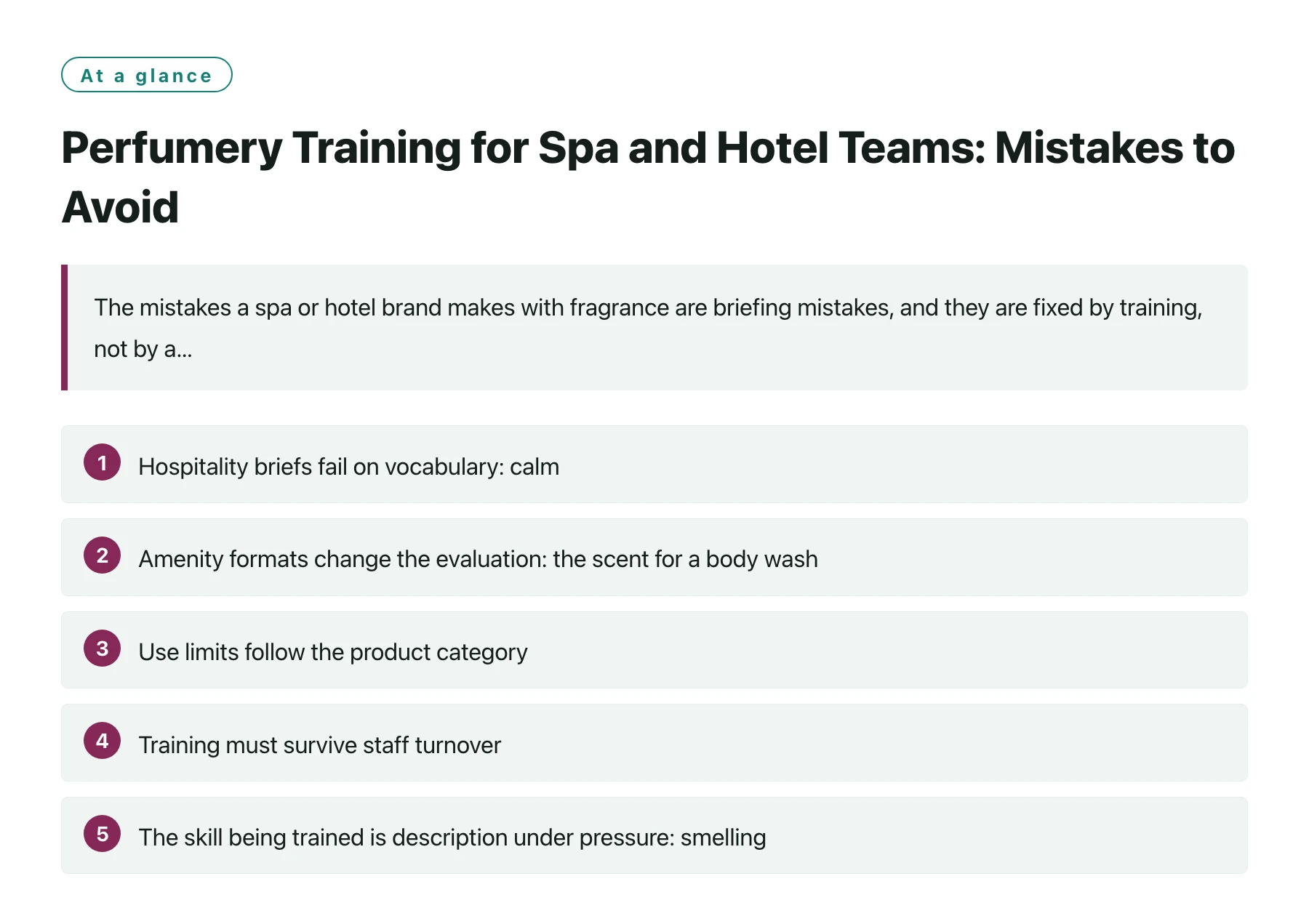
Key takeaways
- Hospitality briefs fail on vocabulary: calm, luxury and natural are moods, and a perfumer cannot dose a mood.
- Amenity formats change the evaluation: the scent for a body wash, a lobby diffuser and a pillow mist has to be judged in the format it will be used in, not on a blotter alone.
- Use limits follow the product category, and a hospitality line spans several categories at once, so the constraint has to be in the brief before the concept [1].
- Training must survive staff turnover, because an amenity programme outlives the person who briefed it.
- The skill being trained is description under pressure: smelling, naming and defending a written note in a few minutes.
Hotels and spas commission scent in three places at once: the amenity range in the bathroom, the scent of the lobby and the retail products at the desk. Those are different products with different bases and different safety profiles, and most hospitality teams brief all three with the same four adjectives.
The fix is not a supplier switch. It is a team that can describe what it wants in terms a perfumer can dose, and the fastest route to that is training aimed at the mistakes below.
Why hospitality briefs go vague
The amenity brief usually arrives as a concept: a calm, natural scent that guests will associate with the brand. Almost every word of that is usable except the ones the perfumer has to work with. Calm is a mood, natural is a claim, and brand association is a marketing outcome. What the perfumer needs is a family, a weight, an intensity and a performance expectation.
The gap between the concept and the brief is where training sits. It is the difference between a team that says 'a soft woody with a hint of green, closer to the skin, lasting through a shower' and a team that says 'something like we smelled at the boutique last year'.
The mechanism underneath is physical: how fast a material evaporates decides when you smell it, in a diffuser or on skin, which is why the same note behaves so differently between formats [2].
Mistake one: judging everything on a blotter
A lobby diffuser, a body wash and a candle deliver scent differently, and the same concentrate behaves differently in each. Teams that evaluate one blotter per direction usually pick the wrong direction for the format. Training should include judging samples in the carrier and at the moment of day guests will meet them.
Mistake two: treating 'natural' as a fragrance family
Natural is a sourcing and labelling position, not a smell. A fully natural brief still needs a family, a weight and an intensity, and it narrows the palette long before the first sample. Teams that learn to brief the smell first and the claim second get closer in the first round.
Mistake three: one vocabulary for three product categories
The amenity, the ambient scent and the retail product sit in different cosmetic categories, and the use limits attached to fragrance materials are set per category [1]. A team that treats them as one scent 'for the hotel' will meet the difference in the safety assessment rather than in the brief.
A short training plan that removes the mistakes
- Build the family map firstFloral, woody, citrus, gourmand, oceanic and the overlaps between them. The map gives the team a shared language before any product talk starts.
- Practise description under time pressureBlind samples, two minutes, one written paragraph each, then compare. The written record is what exposes the gap between smelling and saying.
- Evaluate in the real carrierSmell the candidate directions in the body wash base, the diffuser oil and the candle wax, at the concentration a guest will actually meet.
- Brief against a constraint listEach brief carries the category, the use limits and the claim list next to the description, so the perfumer is not guessing what the market will accept.
- Retain one reference sheet per scentA labelled blotter set and a written note per direction, kept with the product file, so a brief written in March still makes sense in October — or to a successor.
Where to find the training
Training can come from a perfumery academy, from the manufacturer's development team, or from a consultant hired for the season. An academy gives structure and a recognised vocabulary; a manufacturer gives realism about what its palette can deliver; a consultant bends around a launch calendar. The design matters more than the provider.
For a hospitality team, a place to learn perfumery should include supervised smelling practice rather than lectures alone, because the skill is description under pressure. A visit to a scent museum supports the same goal from the other direction: walking a curated collection, like Xuelei Fragrance Museum, builds the reference library the training then organises.
The practical floor is one trained writer and one trained approver per function — purchasing, brand and operations — because those are the two people who turn a concept into a brief and a sample into a decision.
It also helps when the training and the production reference are close together. A manufacturer that runs its own academy and museum, such as Xuelei Fragrance, makes the study trip and the development conversation one journey — but inspect the syllabus before you admire the museum.
Before approving any training budget, write the Friday test: at the end of the programme the team should be able to write a two-line scent brief that includes a family, a weight, an intensity and a use. If the course cannot promise that, it is a tasting.
Sources
- IFRA Standards Library (International Fragrance Association) —— The IFRA Standards Library lists the restrictions the fragrance industry applies to individual fragrance ingredients, based on safety assessments; it is the reference point for compliant fragrance formulation.
- Chemistry World (Royal Society of Chemistry) —— The Royal Society of Chemistry's magazine, covering chemistry research and explanations of everyday materials including aroma compounds.
Frequently asked questions
How long does it take to train a hospitality team to brief scents?
Three half-day sessions spread over a few weeks is usually enough for the basics: the family map, description practice and evaluating in the real carrier. The repetition between sessions is what makes the vocabulary stick, which is why spaced sessions beat one long day.
Does the spa or hotel need an in-house perfumer?
Not usually. One trained writer and one trained approver per function covers most of a hospitality programme. An in-house perfumer only pays off at a scale and frequency most single-property teams never reach.
Why do supplier samples for the same brief keep coming back wrong?
Usually because the brief left no constraint to work against: no family, no intensity, no category, no use limits. Each missing constraint is a sampling round spent rediscovering it. Fix the brief format before the second round.
Can the same scent family serve the amenity, the lobby and retail?
It can be the starting point, but each format changes what the guest experiences and what the safety file must show. Treat them as one family and three products: one brief, three evaluations.
What should we look for in a training provider?
Structured comparison with written output, supervised smelling practice and evaluation in real carriers. Ask what the team will be able to produce at the end; if the answer is a certificate rather than a usable brief, keep looking.